
Architectural Design and History Of Lotus Temple
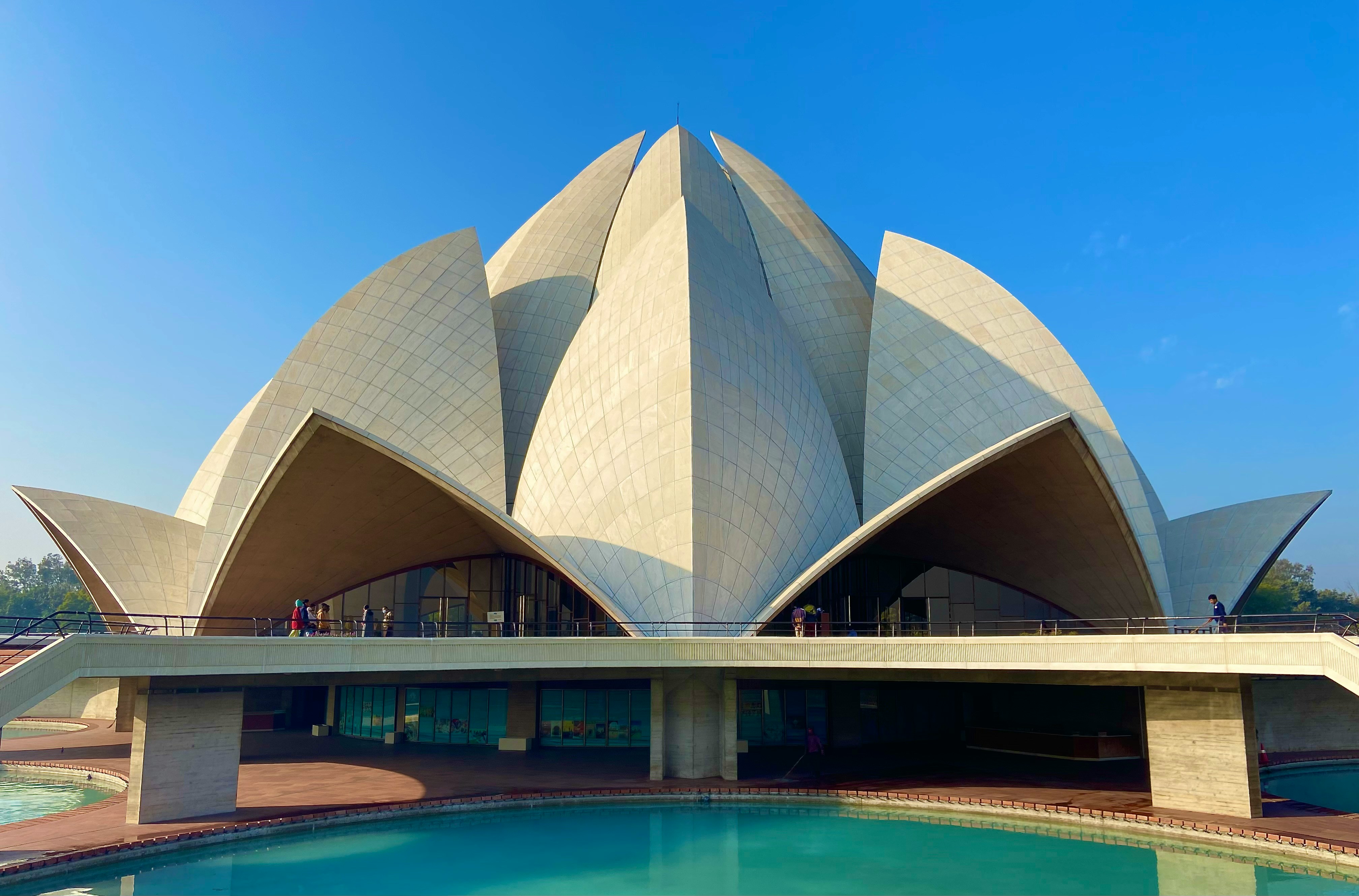
The Lotus Temple, completed in 1986, is one of India’s most iconic pieces of modern architecture. Designed by Iranian architect Fariborz Sahba, it serves as the mother temple of the Baháʼí faith in the Indian subcontinent. Shaped like a blossoming lotus flower, the building is made up of 27 marble-clad “petals” arranged in clusters of three to form nine sides, symbolising unity, openness and the Baháʼí principle of universal oneness.
While it's a house of worship, the Lotus Temple welcomes all; regardless of religion, nationality or background; making it not just a religious site, but a truly democratic architectural space. Since its opening, it has attracted more than 100 million visitors, making it one of the most visited buildings in the world.
A Brief History of the Lotus Temple
The Bahai Lotus Temple has its roots in the 1970s:
Construction begins after a major donation.
In 1976, Iranian architect Fariborz Sahba was hired to design a new Bahá’í temple in New Delhi. A Bahá’í practitioner, Ardishír Rustampúr of Hyderabad, donated his life savings in his will toward building a new temple, which the faith used to purchase land in the Bahapur village of New Delhi. Construction on the temple began shortly after.
The temple opens to practitioners and the public.
In 1986, the Lotus Temple was dedicated and opened to both practitioners of the Baháʼí Faith and the general public. Soon after its completion, it won several architectural awards, including the Institution of Structural Engineers’ award for excellence in religious art and architecture and the GlobArt Academy 2000 award.
The temple breaks a world record.
The Lotus Temple is the most visited building in India (passing up even the Taj Mahal) and one of the most visited religious tourist attractions in the world according to the Guinness World Records, boasting over 10,000 visitors per day.
Architectural Style of the Lotus Temple
The Lotus Temple is an example of modern architecture that captures the simplicity and beauty of lotus flowers in its design. Composed of 27 free-standing marble petals arranged into clusters of three, nine doors lead to its central hall, which can accommodate up to 2,500 people while featuring nine reflecting pools; it stands as proof that Western and Indian architectural styles can come together beautifully in its construction.
The number nine is sacred in the Bahá’í faith. Thus, the Lotus Temple (like many other Bahá’í houses of worship) incorporates the number nine in a symmetrical pattern for balance and beauty for instance, the building is shaped in a nine-sided dome. The 27 concrete-and-marble petals that make up the structure are split into three different types: nine entrance leaves (which mark the doorways), nine outer leaves (which form the roof space), and nine inner leaves (which enclose the central hall in an interior dome).
The structure is composed of three ranks of nine petals each, springing from a podium which elevates the building above the surrounding plain.
The first two ranks curve inward, embracing the inner dome, while the third layer curves outward to form canopies over the nine entrances. The double layered interior dome, modelled on the innermost portion of the lotus, comprises 54 ribs with concrete shells in between. The central hall has a diameter of 34 metres and a height of 33.6 metres above the podium.
It is ringed by nine arches which provide the main support for the superstructure. With a seating capacity of 2,200, the hall has no idols, no photographs and no priests. Besides the main hall, the complex consists of an ancillary block with a reception centre, a library and an administrative office.
The entire superstructure is designed to function as a series of skylights with glazing at the apex of the inner petals, underneath the outer petals and on the external side of the entrance petals. Light thus filters into the central hall in the same way as it passes through the lotus flower.
External illumination is so arranged as to make the lotus structure appear to float on water. The building embodies effective ventilation and cooling techniques. Fresh air, cooled as it passes over the fountains and pools, is drawn in through openings in the basement up into the central hall and expelled through a vent at the top of the structure.
The reinforced-concrete petals are clad in white marble panels, done to fit the surface profiles and to patterns related to the structure's geometry. White marble also covers all the interior floors, while the insides of the petals are bush-hammered concrete. The walkways and stairs in the podium are finished in the local red sandstone.
Environmental considerations and Sustainability:
In design, the Lotus Temple aimed to prioritise environmental sustainability, generating 20 per cent of its electricity needs through a set of solar panels on the roof, using openings at the top and bottom of the building to encourage natural ventilation, and installing a large glass and steel skylight at the top of the structure to let in natural light.
There are 400 photovoltaic panels, each generating 250 KW. The electricity is used for cooking and lighting. The smart move saves electricity and also inspires other tourist sites to adapt to solar power.
How to get there: Route options for Travellers
The Lotus Temple is located in Bahapur, Kalkaji, South Delhi; around 12km from the city centre.
Metro:
The easiest way is via the Delhi Metro; hop off at Kalkaji Mandir Station (Violet Line), a short 5-minute walk to the temple.
Auto-Rickshaws & Taxis:
Widely available, especially from major hubs like Connaught Place or New Delhi Railway Station. Use Uber to check prices before jumping into one, though.
Buses:
DTC buses serve the area, though traffic can be heavy and frankly they are not that easy to navigate; metro is a more reliable option.
Architectural approach used in Lotus Temple
Inspired by Nature:
The lotus motif is rooted in Indian cultural symbolism, representing purity and spiritual awakening, while also embracing modernist forms.
Material:
Made from pristine white marble from the Penteli mountain in Greece, the same source used for the Parthenon.
No Icons or Altars:
The interior is deliberately minimal, with no pulpits, statues or symbols; letting the geometry, light and spatial quality take centre stage.
Natural Light & Ventilation:
Ingeniously designed skylights at the top of each petal allow diffused sunlight to bathe the interior; a passive cooling system further adds to its sustainability.
Reflecting Pools:
Surrounding the temple, the pools mirror the structure and help in natural cooling; a nod to Mughal garden design while also functional.
Lotus Temple: A Spiritual Marvel of India
As the Lotus Flower holds immense importance in different cultures, the shape signifies the unity of different people from all walks of life. You can witness each petal symbolising harmony, purity and oneness. Just as the lotus grows in muddy water yet blooms brightly, it stands as a beacon of hope and sunshine in lives.
The temple plays a significant role in promoting the message with its magnificent structure. People from any religion, caste or creed can offer their services in the temple. National as well as international tourists, no matter their background, are allowed to pray and meditate in this mesmerising structure.